Nobody Started a Meal Train for the Woman Who Never Needed One

Let's talk about the group text.
Not the one you accidentally started at 11 p.m. when you sent a video of your cat doing something inexplicable with a paper bag, which generated forty-seven responses over three days from people who had not communicated with you in months. That group text was thriving.
The other one. The one nobody started when you had knee surgery in March.
The Infrastructure You Didn't Know Was Optional
Somewhere in America, right now, a grandmother is recovering from the exact same outpatient procedure you had. Her kitchen counter has three casserole dishes on it. Her neighbor has already taken the dog out twice. Her daughter called this morning and her son-in-law offered to handle the pharmacy pickup. A woman from her church whom she genuinely barely knows dropped off a lemon pound cake because that is apparently just what happens when you are embedded in a community that has been quietly practicing mutual aid for decades.
You came home in a rideshare because the discharge instructions said you needed someone to drive you and you didn't want to impose, so you solved the problem the way you've solved every problem since 1987: efficiently and alone.
The cat was on the couch. This was, objectively, comforting.
But here's the thing nobody tells you, and the thing that takes most high-achieving childless women until their early sixties to fully absorb: the care infrastructure that surrounds mothers and grandmothers didn't appear by magic. It was built. Over decades. Through an accumulation of meal trains joined, baby showers attended, school pickup favors extended, and a thousand small acts of showing up that created, over time, a network of reciprocal obligation so dense and automatic that it mobilizes without anyone having to ask.
You were not building that network. You were building something else entirely. Something impressive, no question. But not that.
The Self-Sufficiency Signal You Sent (And Sent, And Sent)
Here is the uncomfortable truth at the center of this conversation: you told everyone you were fine. For forty years. You told them with your promotions and your problem-solving and your cheerful ability to handle everything without assistance. You told them with your 'oh, don't worry about me' and your 'I've got it covered' and your genuine, sincere, deeply internalized belief that needing people was a kind of weakness that high-functioning adults were supposed to outgrow.
The people in your life received this message. They are not mind readers. They responded to the information you provided.
When your colleague Sarah had her hip replaced, eleven people organized a rotating check-in schedule because Sarah had three kids and five grandchildren and had spent thirty years being the person who showed up. The network showed up for Sarah because Sarah had been making deposits into that account since the Carter administration.
 Photo: Sarah, via images.squarespace-cdn.com
When you had your knee done, your work friend Diane sent a very nice text that said 'thinking of you!' with a small bandage emoji. She meant it sincerely. She also has two grandchildren under four and approximately zero bandwidth for anything outside that gravitational field, which you understood completely because you are a reasonable person.
 Photo: Diane, via people.com
The cats checked on you every twenty minutes. They were excellent about it.
The Meal Train Problem
MealTrain.com — and its various competitors in the casserole logistics space — is one of the most revealing artifacts of contemporary American social life. It is a website that exists entirely to coordinate the feeding of people who are going through something. Surgery. New baby. Loss. Illness.
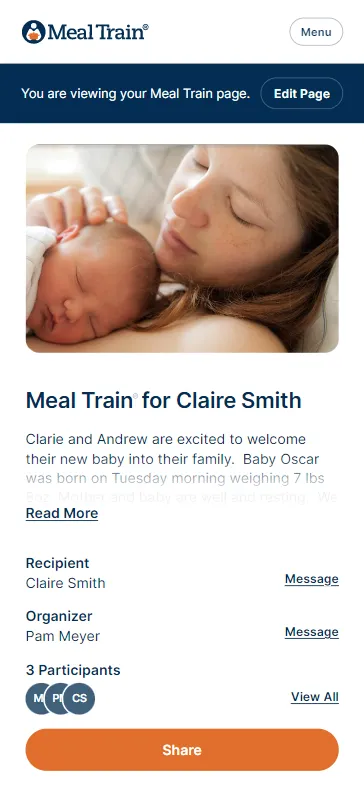 Photo: MealTrain.com, via s3.amazonaws.com
The interesting thing about meal trains is not the food. It's the activation energy. Someone has to start one. And the person who starts one is almost always someone embedded in the same community network as the recipient — someone who knows the other people who would sign up, who has the social standing to send the email, who understands that this is simply what the community does for its members.
For women who built their social lives around professional networks rather than neighborhood and family networks, there is often no one who has both the knowledge and the standing to start the train. Your colleagues are scattered across three time zones. Your professional contacts are exactly that — professional. The neighbors know you exist but not enough about your life to know when something has gone wrong.
Your emergency contact, upon review, is a coworker from a job you left in 2019 who you listed because the form required a name and she was the first person who came to mind. She is a perfectly lovely person. She has absolutely no idea you had surgery.
What Tuesday Discharge Actually Looks Like
The hospital discharge process is designed around an assumption so foundational that nobody at the hospital has thought to question it in decades: that someone is coming to get you.
Not an Uber. A person. A person who will also receive the discharge instructions, help you remember what the doctor said, stop at the pharmacy, and be present in your home for the first twenty-four hours because that is what the paperwork specifies should happen.
When you discharge alone on a Tuesday at 2 p.m., you encounter a small but consistent series of moments where the system's assumptions and your reality do not quite align. The nurse asks who's coming. You say you've arranged a car. She writes something in the notes. The discharge coordinator says 'your family can call us with questions.' You nod. The pharmacist asks if you need anything explained for the caregiver. You say you are the caregiver.
None of this is cruel. It is simply a system that was designed for a life you didn't build.
The cat is genuinely very helpful when you get home. Emotionally, anyway. Physically, the limitations are significant.
Building the Network Before You Need It
The women who have done this well — and they exist, and they are worth listening to — did not wait for the surgery to notice the gap. They started building the network in their fifties, deliberately and without embarrassment, the same way they would have approached any other gap analysis at work.
They joined things. Not professionally. Locally. They learned their neighbors' names. They started showing up for other people's moments — the ones that didn't benefit them professionally, the ones that were purely about being present. They invested in friendships that were geographically close rather than impressive on paper.
They built the meal train network before they needed the meal train.
It is not too late. It is, however, later than you planned. And the cat, while deeply committed to your recovery, cannot drive to the pharmacy.
Somebody should probably know your address.