Somebody Set You a Folding Chair: The Annual Thanksgiving Seating Arrangement That Says Everything
The Most Honest Furniture in America
Somewhere in a garage in suburban Ohio, there is a folding table that knows more about the American social order than any political science textbook ever written. It gets dragged out once a year, covered in a paper tablecloth printed with cartoon pilgrims, and assigned to a rotating cast of children who will eventually outgrow it. The women who built careers instead of families, however, never quite do.
Welcome to Thanksgiving — the one holiday that reorganizes itself entirely around reproduction and then has the audacity to serve you a bread roll while it does it.
The grandchildren's table is not, strictly speaking, about children. It is about proof. It is a physical ledger of biological investment, arranged in ascending order of who brought the most stakeholders to dinner. Grandmothers command the head. Mothers of toddlers get the chair closest to the kitchen for logistical reasons everyone pretends are practical. And the woman who made partner in 2009 and has two very emotionally complex rescue cats? She gets seated next to the teenager who would rather be anywhere else, which, honestly, same.
How the Seating Chart Became a Social Verdict
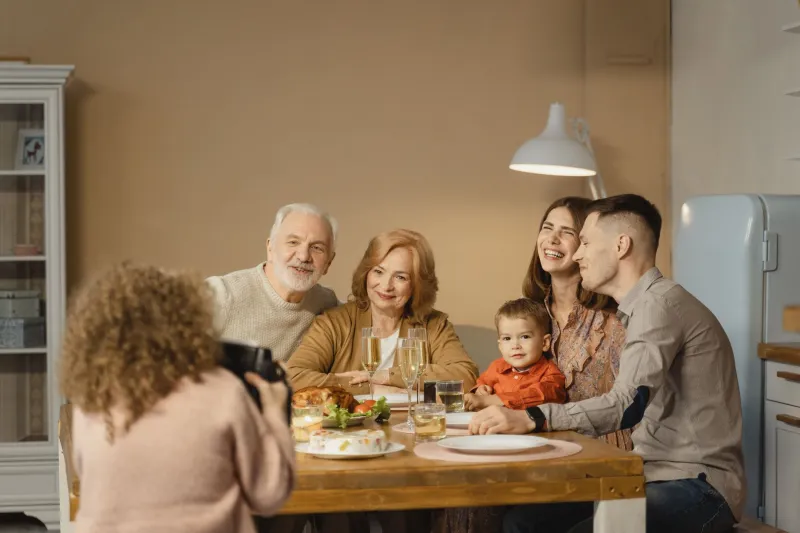
Think about what a Thanksgiving table actually communicates before anyone says grace. The architecture of it. The high chair bolted to the edge like a small throne. The booster seats. The sippy cups arranged with military precision by someone who has clearly done this before. The grandchildren's table in the corner, sticky with legacy and cranberry sauce.
None of this happened by accident. American Thanksgiving evolved over decades into a ceremony that celebrates, above all else, continuation. The family that multiplied. The bloodline that held. And if your personal chapter of that story ends with you — if the family tree you belong to terminates at your LinkedIn profile — you are not exactly the honored guest at this particular feast.
You are, at best, a beloved supporting character in someone else's holiday movie. At worst, you are the cautionary tale the younger cousins will reference in hushed tones on the drive home.
The Career That Didn't Come with a Plus-One Seating Policy
Here is what nobody mentioned at the women's leadership conference in 2001: that the boardroom victories you were accumulating would not translate into Thanksgiving seating arrangements. That the promotions, the salary negotiations, the glass ceilings you personally shattered with your bare ambition — none of it would reserve you a spot at the grown-up table when grown-up was redefined to mean "brought grandchildren."
The women who spent their thirties in airports and conference calls while their peers were at pediatrician appointments are now, at sixty-something, experiencing a very specific kind of social reclassification. They arrive at family Thanksgivings — or friends' Thanksgivings, or the Thanksgiving they were graciously invited to because someone felt bad — and they are absorbed into the gathering as a kind of interesting artifact. The one who had The Career. The one who Traveled. The one who is, bless her heart, still very sharp.
Sharp enough to notice the seating chart. Sharp enough to count the grandchildren. Sharp enough to do the math on thirty years of choices while someone else's two-year-old launches a dinner roll across the room and everyone laughs like it's the best thing they've ever seen.
The Drumstick Goes to the Stakeholders
There is a specific ritual at large Thanksgiving gatherings where the grandchildren fight over the drumstick. It is loud and theatrical and everyone finds it charming. The grandparents beam. The parents referee with practiced exhaustion. The aunts and uncles make knowing faces at each other.
If you are a woman over sixty without children or grandchildren of your own, you watch this scene with a feeling that is difficult to categorize. It is not quite envy. It is not quite grief. It is something closer to the sensation of watching a movie in a language you almost speak — familiar enough to follow, foreign enough to remind you that you are not quite inside it.
The drumstick ceremony is not about poultry. It is about belonging to something that continues. The children who fight over it will grow up and bring their own children to fight over future drumsticks. The table will expand. The paper tablecloth will get replaced. The folding table in the garage will keep getting dragged out, year after year, for the next generation of people who earned their seat by existing.
Your 401(k) does not enter into it.
Permanent Guest Status and What to Do With It
There is a certain freedom in permanent guest status, if you squint at it right. You do not have to host. You do not have to coordinate seventeen dietary restrictions or source a gluten-free stuffing that doesn't taste like regret. You arrive, you contribute a very good bottle of wine, and you leave when you want to — which is a luxury the woman with three children under eight would trade her entire career for right now, actually.
But freedom and belonging are not the same thing, and Thanksgiving is specifically not about freedom. It is about the opposite of freedom. It is about obligation and tradition and the particular warmth of being woven into something larger than yourself. It is about the chaotic, exhausting, occasionally infuriating experience of being needed by people who share your DNA.
The women who optimized their way out of that experience in their thirties are now, in their sixties, encountering its absence in the most seasonal and unavoidable way possible. Once a year, every year, the calendar hands them a Thursday and says: here is your annual accounting. How are the cats?
The Table You'll Never Host
The grandchildren's table you will never host is not just furniture. It is a particular kind of future — loud, sticky, exhausting, and irreplaceable — that does not arrive via career achievement or financial planning or any of the mechanisms you spent decades mastering.
It arrives, if it arrives, via choices made much earlier, in years when the conference calls felt more urgent than the biological clock everyone around you was apparently listening to.
The turkey knew. The turkey always knew.
Set an extra place for the cats. They, at least, will be there for the leftovers.