Forty Years of Christmas Cards and the Address Book That Knows Too Much

Somewhere in America right now, a woman is sitting at her kitchen table in early December with a glass of Merlot, a sheet of address labels, and the dawning realization that her Christmas card list has reorganized itself without her permission.
The cats are watching. They always watch.
The address book — whether it lives in a leather-bound journal, a Google contact list, or a shoebox of accumulated holiday card returns — is one of the most honest documents a human being will ever produce. More honest than a resume. More revealing than a therapy intake form. It is, if you look at it correctly, a forty-year ledger of social belonging. And for a certain generation of women who chose corner offices over nurseries, that ledger has some interesting things to say.
How the List Grows (And Then Doesn't)
In your twenties and thirties, the Christmas card list is an act of optimism. You add everyone. College roommates. Work colleagues. The neighbor whose dog you watched once. Your dentist's receptionist, briefly, after a particularly warm December interaction. The list balloons because you are everywhere, doing everything, and the world is enormous and full of people who might matter.
This is the phase where the list feels like evidence of your vitality.
Then something happens around your mid-forties. Not to your list — to everyone else's. The cards that start arriving feature photographs. Not professional headshots, not vacation snapshots, but family portraits. And not just couples. Families. The exponential kind. Your college roommate sends a card featuring herself, her husband, three children, two in-laws who apparently now live nearby, and a golden retriever named Biscuit who appears to be the emotional center of the operation.
You send back a card with your name on it. Just your name. Maybe a tasteful winter scene. The Currier & Ives kind, because you have excellent taste, which was always the point.
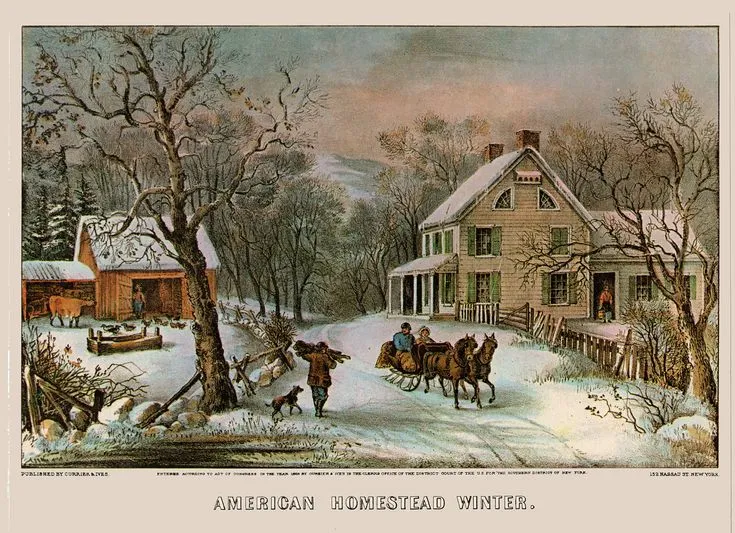 Photo: Currier & Ives, via i.pinimg.com
The Reorganization Nobody Announced
Here is what nobody tells you about Christmas card lists: they are secretly social infrastructure maps. The people on your list aren't just addresses. They are nodes in a network, and over time, those networks either expand outward through children and grandchildren and school fundraisers and neighborhood soccer leagues — or they don't.
For women who built careers instead of family trees, the list does something quietly devastating around the sixty-year mark. It doesn't disappear. It reorganizes. The cards you receive start arriving from people you know through their families rather than through themselves. Your former colleague sends a card signed by her, her husband, her three adult children, and the names of four grandchildren you've never met but whose existences have been thoroughly documented across fourteen years of holiday correspondence.
You send back a card signed by you. And Muffin. (You added Muffin to the card one year as a joke and now it's simply the tradition.)
The outgoing stack gets smaller every year, not because you've lost friends, but because the social math has shifted. Couples who used to send individual cards now send one family card that covers seventeen people. You are still one card. The ratio is not improving.
The Meticulous Recorder's Particular Grief
There is a specific kind of woman who kept perfect records. Who noted in the margin of her address book when someone moved, who crossed off names with a single clean line rather than a scribble, who saved particularly beautiful cards in a box organized by year. This woman — and you may recognize her — has accidentally assembled one of the most comprehensive chronicles of other people's joy in existence.
She knows that the Hendersons moved to Phoenix in 2009 to be near their daughter. She knows that the Pattersons added a hyphen to their last name when the grandchildren started arriving, for reasons of clarity. She knows that Diane from the marketing department stopped sending cards after 2018, which she later learned was because Diane's whole social life had collapsed inward around her grandchildren's schedules in a way that left no room for people outside the orbit.
She recorded all of it. She sent cards to all of it. She was a model correspondent.
And now she is sixty-three, and the box of incoming cards from this year fits in a shoebox with room to spare, and several of the senders are people who she suspects only kept her on the list out of inertia and mild guilt.
What the Shrinking Stack Actually Means
Let's be precise about what's happening, because the instinct is to frame this as a failure of friendship or a consequence of getting older. It is neither. It is something more structural and, frankly, more interesting.
The Christmas card list is a snapshot of your social surface area — the number of people for whom your existence registers in a meaningful way across the calendar year. For grandmothers, that surface area expands automatically and continuously. Every grandchild is a new node. Every school play, every soccer tournament, every pediatrician waiting room introduces new people who become new connections. The grandmother's social surface area grows without effort because family is a social expansion engine.
For the childless woman at sixty, the surface area depends entirely on active maintenance. It does not grow on its own. It requires cultivation, intention, and the kind of energy that is increasingly hard to manufacture when the culture has quietly stopped designing social structures with you in mind.
The Christmas card list knows this. The Christmas card list has always known.
A Modest Proposal for December
Here is what the women with the meticulous address books are doing now, and it is genuinely worth considering: they are starting over. Not with fewer cards, but with different ones. Cards to the neighbors they've been meaning to know better. Cards to the former colleagues who also never had children and who are probably also sitting at their kitchen tables with address labels and complicated feelings. Cards to the women from the book club who are, statistically, in the same situation.
The Christmas card list is not a verdict. It is a tool. And forty years of keeping everyone else's addresses means you know exactly where to find the people who might be relieved to hear from you.
Send the card. Add the cat's name if you want. Muffin deserves the credit.