The Kitchen Designed for a Life That Never Showed Up: Marble Countertops, Premium Appliances, and Dinner for One
The Wolf range arrived on a Tuesday in October, and it was, without question, the most beautiful thing that had ever been installed in a home you owned outright. Six burners. A griddle attachment. A convection oven that could — according to the salesman, who clearly understood his audience — handle a twenty-two-pound turkey with room to spare.
You have never cooked a twenty-two-pound turkey. You have, however, used the griddle attachment to make a single grilled cheese at 9 p.m. on a Wednesday while a cat named Biscuit watched from the island with the focused attention of a food critic who has seen better days.
This is the story of the American dream kitchen. Specifically, the version nobody warned you about.
The Renovation That Announced Your Arrival
Somewhere in the late aughts and early 2010s, the open-concept kitchen became the primary language of personal achievement for professional women. It wasn't just a room. It was a declaration. The demolished walls said: I have succeeded. The waterfall marble island said: I entertain. The farmhouse sink said something that was never entirely clear but definitely involved the word intentional.
The cookbooks followed naturally. Not the spiral-bound church fundraiser variety that your mother kept in a drawer and actually used. The architectural cookbooks. The ones with photography so beautiful they belong in a gallery and recipes so complex they require a mise en place that takes longer than the workday you just survived. They live on your open shelving now, spines perfectly aligned, contributing enormously to the aesthetic and essentially nothing to your dinner.
The kitchen was designed for a life. A specific life. The one where Sunday dinner is a production, where holidays require the full deployment of every burner, where the island seats six and all six seats are occupied by people who are loud and hungry and entirely too comfortable in your home.
That life was supposed to arrive after the career stabilized. After the right relationship materialized. After the timing finally worked out.
The timing, as it turns out, had other plans.
What the Dinner Party Circuit Was Actually Building
For a while, the kitchen earned its keep. Your thirties and forties were genuinely social. The dinner parties happened. The friends came. The bottles of wine were opened with purpose and the island fulfilled its seating potential on more than one occasion.
But here's the thing about dinner party social networks that nobody puts in the lifestyle magazine: they are not self-sustaining. They require maintenance. And maintenance requires time. And time, as every woman who spent her prime decades building a career knows, was the one resource that was always spoken for.
While you were optimizing your professional network and attending the right conferences and making the strategic lateral moves that eventually paid off handsomely, your dinner party guests were busy building something else entirely. They were building the kind of social infrastructure that doesn't need scheduling. Their kitchens got loud not because they planned it, but because they had children, and children bring chaos, and chaos brings people, and people — eventually, inexorably — become the kind of community that shows up without being invited.
The dinner parties thinned out gradually. Kids' schedules. Suburban moves. The natural drift of lives organized around different centers of gravity. By 58, the island that seats six was mostly seating one, with occasional overflow accommodations for a rotating cast of cats who did not appreciate the Ottolenghi recipes but were very interested in the salmon.
The Cookbook Problem
Every cookbook in your collection was written with an assumption baked into the page count: that you have people. Not just a person. People. The kind of people who generate leftovers as a reasonable goal, not a logistical problem.
The Ina Garten school of cooking, which has done more for the premium home kitchen industry than any single force in the last thirty years, is essentially a love letter to the dinner table as community anchor. Ina's kitchen is always full of Jeffrey and friends and the particular warmth of a life organized around feeding people you love.
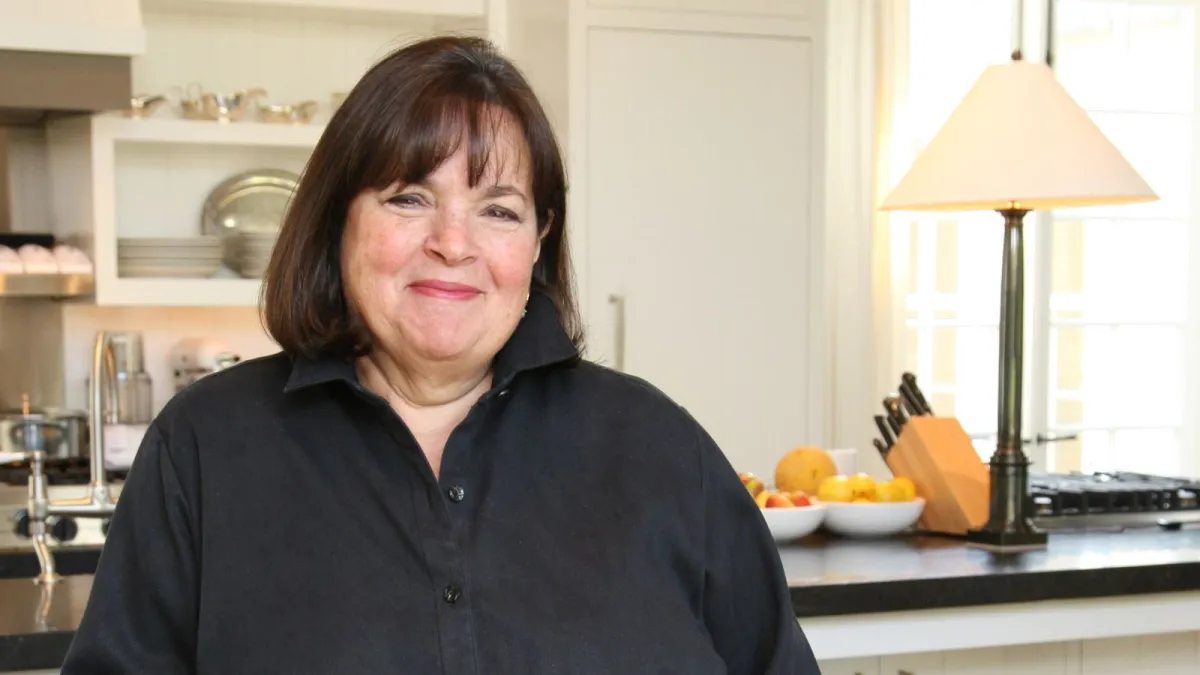 Photo: Ina Garten, via cdn.mos.cms.futurecdn.net
You own four Ina Garten cookbooks. You have made the roast chicken twice. It was excellent. You ate it for four days. The cats staged a formal protest about the lack of sharing.
The single-recipe scaling apps have gotten better, which is something. You can now halve and quarter most recipes with reasonable accuracy. But there is no app that scales the feeling of a full table. There is no algorithm that replicates the specific pleasure of cooking for people who are hungry and grateful and entirely too opinionated about whether the pasta needs more salt.
The Appliance Inventory at 63
Let's do an honest accounting of the kitchen you built:
The six-burner range is used on approximately two burners, most evenings. The wine refrigerator holds an impressive selection that you work through at a responsible pace, alone, which is either sophisticated or slightly concerning depending on your perspective. The stand mixer, which cost more than your first car, makes an appearance at the holidays and occasionally for the kind of stress-baking that a therapist would probably want to discuss.
The single-serve coffee maker is, without question, the most-used appliance in the kitchen. It asks no questions. It requires no audience. It delivers exactly one cup of exactly the coffee you wanted, every single morning, reliably and without drama.
In a way, it is the perfect metaphor for the life you built. Efficient. High quality. Precisely calibrated to your individual needs. Completely optimized for a party of one.
The Marble Doesn't Care
Here is what your kitchen cannot tell you, because marble is beautiful but not particularly conversational: the women who spent their prime years cooking in modest kitchens for noisy, ungrateful, perpetually hungry families are now, at 65, presiding over the most socially rich phase of their lives. Their kitchens are full again. Different people, different chaos, but full.
The grandmother with the Formica countertops and the thirty-year-old electric range is cooking Sunday dinner for twelve right now. Her kitchen is not featured in any magazine. Her cookbooks are stained and annotated and falling apart at the spine. She has never heard of a waterfall island and she could not care less.
But she has someone to feed. And at 63, that turns out to matter more than the countertops.
Your kitchen is genuinely stunning. The light in the afternoon is extraordinary. The cats have excellent taste in napping locations, and Biscuit has developed a sophisticated palate for anything that falls off the cutting board.
It's a beautiful room.
It just needed a different story to go with it.